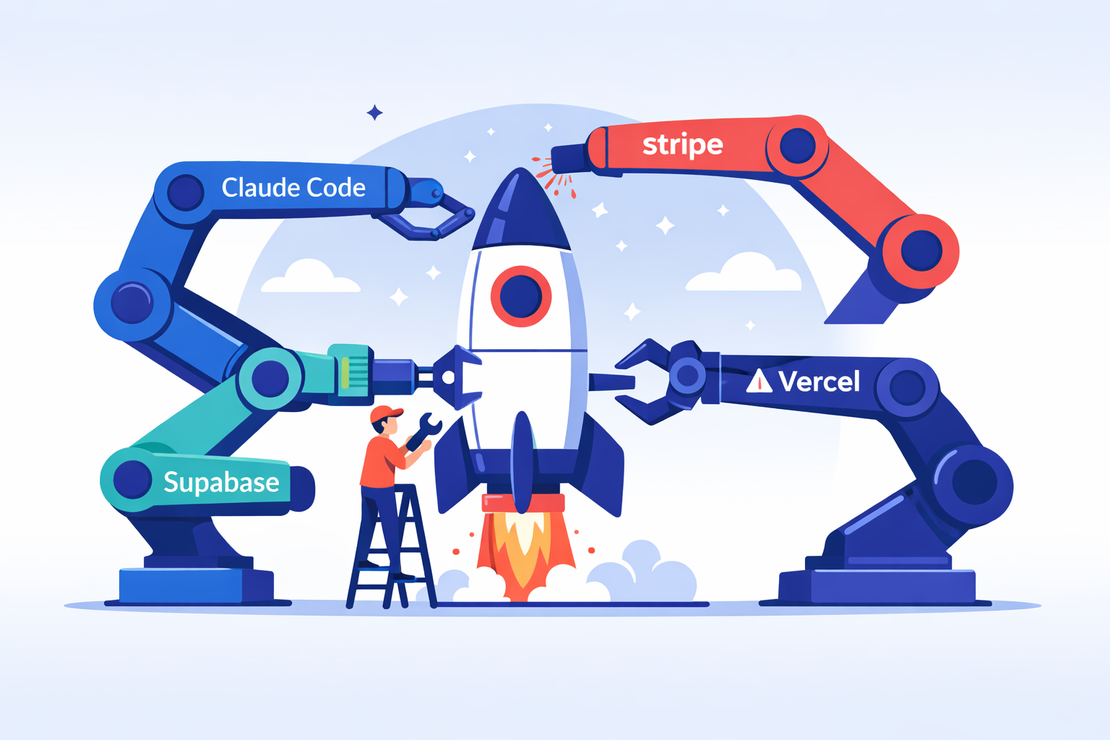
Bootstrapping an AI Startup in 2026: The No-VC Playbook for Founders
- Sainam Technology
- April 8, 2026
Table of Contents
Bootstrapping an AI Startup in 2026: The No-VC Playbook for Founders
The Moment You Realize You Don’t Need Their Money
You’re sitting across from a VC partner. You’ve practiced your pitch 40 times. You have a beautiful deck. You talk about TAM, SAM, SOM. They nod. They ask about your fundraising round. They say they’ll circle back.
They don’t circle back.
Two months later, you’re still waiting for permission to build. You’re still “in conversations.” Your idea is still just an idea.
Meanwhile, another founder — no pitch deck, no connections, no VC intro — launched a $12K MRR AI tool two weeks ago. Alone. With Claude Code, a $29/month Vercel account, and a Stripe dashboard that made her cry tears of joy on launch day.
This is the new reality of building AI startups in 2026. The cost of entry has collapsed. The leverage has never been higher. And the founders who understand this are building profitable companies without asking anyone’s permission.
This is how they’re doing it.
Why Bootstrapping AI Startups Is Different Now
Three years ago, building an AI product required:
- $500K+ in compute costs
- A machine learning team
- Months of model training
- Proprietary datasets
Today, you need:
- An API key
- A domain name
- A clear problem worth solving
The commoditization of foundation models — GPT-4, Claude, Gemini — means that any solo founder with a laptop and $50/month in API credits can build products that would have required a Series A team in 2022.
This changes the bootstrapping calculus entirely.
The Old Bootstrapping Math:
- Build for 12 months
- Spend $80K in savings
- Hope users come
- Maybe reach profitability in year 3
The New AI Bootstrapping Math:
- Build MVP in 2-4 weeks (with AI-assisted dev tools)
- Spend $3K–8K total before first revenue
- Validate with 10 paying customers in month 1
- Reach profitability in month 2–4
This isn’t theory. Founders are doing it right now. Let’s break down exactly how.
The Foundation: Choosing the Right AI Startup Model
Not all AI startups are created equal. Some are venture-scale opportunities. Others are lifestyle businesses. Bootstrappers need to be surgical about which they’re building.
The Four Bootstrappable AI Business Models
| Model | Description | Revenue Potential | Bootstrappability |
|---|---|---|---|
| AI Wrapper | Thin UX layer on top of existing API | $5K–$50K MRR | ★★★★★ |
| AI Workflow Tool | Automates a specific business process | $10K–$100K MRR | ★★★★☆ |
| AI Vertical SaaS | Full product for a specific industry | $20K–$500K MRR | ★★★☆☆ |
| AI Data Product | Proprietary dataset + intelligence layer | $50K–$1M+ MRR | ★★☆☆☆ |
For bootstrappers, the sweet spot is AI Workflow Tools. They’re complex enough to create real value (and charge real prices), but scoped enough to build solo in 4-6 weeks.
Real Examples of Bootstrapped AI Workflow Tools in 2026:
- A tool that generates first drafts of legal contracts from plain-language descriptions → $18K MRR
- An AI that monitors competitor pricing across e-commerce sites and suggests repricing strategies → $22K MRR
- A system that processes invoices, extracts line items, and reconciles them against POs in QuickBooks → $31K MRR
- An AI that listens to sales calls and generates personalized follow-up emails → $14K MRR
Each of these was built by a single founder. Each reached profitability within 60 days. None raised venture capital.
Phase 1: Idea Validation (Week 1-2)
The most expensive thing a bootstrapper can do is build the wrong thing. Validation before code is not optional.
The 5-Customer Rule
Before writing a single line of code, you need 5 people who will pay for your solution. Not “interested.” Not “that sounds cool.” Actually pay.
Here’s how to find them:
Step 1: Define the pain in one sentence
“I help [specific job title] at [specific company size] who struggle with [specific workflow] by [specific solution] so they can [specific outcome].”
Bad: “I help businesses with AI automation.” Good: “I help accounts payable managers at 50–500 person companies who waste 3 hours/day manually processing invoices by automating extraction and reconciliation so they can close the books 40% faster.”
Step 2: Find your 5 in the right communities
- LinkedIn (target the exact job title)
- Reddit communities (r/accounting, r/legaladvice, r/smallbusiness — depending on your vertical)
- Slack communities (industry-specific)
- Twitter/X (#buildinpublic, industry hashtags)
- Your own network (often overlooked)
Step 3: The outreach message that works
Hi [Name],

I'm building a tool that [specific outcome for their role].

I'm not selling anything. I'm trying to understand if this
is a real problem before I build it.

Would you be willing to jump on a 15-minute call this week?
I'll Venmo you $25 for your time (seriously).
That last line does two things: filters for people with the problem (they’ll say “don’t worry about the $25”), and signals you’re serious.
Step 4: Convert calls to pre-sales
After your discovery call, if the problem is real, say this:
“I’m planning to build this. It’ll be $[price]/month. I’m only taking 10 founding customers at 50% off forever. If you’d like to be one, I can take your card today and you won’t be charged until the product is live in [4 weeks].”
If 5 out of 20 conversations result in a card on file, you have product-market fit validation. Build it.
Phase 2: Building Your MVP (Week 2-6)
Once you have pre-sales, you have a deadline. This is a feature, not a bug. Constraints produce focus.
The Lean AI Stack for 2026
The goal is minimum viable infrastructure with maximum AI leverage:
Frontend:
- Next.js or Remix (React-based, fast deployment)
- Tailwind CSS (no design system needed)
- Vercel (free tier handles early traffic)
Backend:
- Node.js or Python (depends on AI library ecosystem)
- Supabase or PlanetScale (managed database, generous free tiers)
- Vercel Edge Functions or Railway (serverless backend)
AI Layer:
- Anthropic Claude API (best for reasoning and text tasks)
- OpenAI API (best for broad general use)
- Replicate (best for image/audio models)
Payments:
- Stripe (subscriptions, one-time payments, invoicing)
Auth:
- Clerk or Auth0 (never build auth from scratch)
Monitoring:
- Sentry (errors)
- PostHog (product analytics — free tier is generous)
Total monthly cost for early-stage: $50–200/month
Using Claude Code to Build Your MVP
This is where bootstrapped founders get their unfair advantage. Claude Code compresses weeks of development into days.
A typical AI workflow tool MVP requires:
- User authentication and onboarding
- API integrations (to the data source you’re processing)
- Core AI processing pipeline
- Results dashboard
- Billing integration with Stripe
- Email notifications
With traditional development: 6–10 weeks solo. With Claude Code: 2–3 weeks solo.
How to use Claude Code effectively for your MVP:
I'm building an AI tool that [describe your product].

Tech stack: Next.js, Supabase, Tailwind, Stripe

Here's the user flow:
1. User signs up and connects their [data source]
2. User uploads/connects [input data]
3. Our system processes it using Claude API to [extract/generate/analyze]
4. User sees results in a clean dashboard
5. User can export or take action

Current database schema:
[paste your schema]

Build me [specific feature] with:
- Input validation
- Error handling
- Loading states
- Success feedback
The specificity is what makes the difference. Vague prompts return vague code.
What to Build and What to Skip
Every week you spend building something users don’t care about is a week of runway burned.
Build in your MVP: ✅ The core AI feature (your reason to exist) ✅ Basic auth (login/signup) ✅ Stripe billing (without payment, you don’t have a business) ✅ The output format users care about most ✅ One export/share option
Skip for now: ❌ Team collaboration features ❌ Permissions and roles ❌ Advanced settings ❌ Mobile optimization (unless mobile-first is core to your product) ❌ API access ❌ Integrations beyond the minimum
You can add everything else after you have revenue. Revenue gives you breathing room. Breathing room gives you the time to build the right things.
Phase 3: Pricing Your AI Tool
Pricing is strategy. Most bootstrappers underprice because they’re scared. This is the single biggest mistake you can make.
The AI Pricing Advantage
Here’s the thing about AI tools: they replace labor. And labor is expensive.
If your tool saves a marketing manager 5 hours per week, that’s 20 hours per month of recaptured time. At $80/hour fully burdened cost, that’s $1,600/month in value created.
Why would you charge $29/month?
The Value-Based Pricing Framework
Calculate the value you create:
- Time saved per week × average hourly rate of user role
- OR Revenue generated × your attribution percentage
- OR Cost avoided (software replaced) × your value percentage
Price at 10–20% of value created
If your tool saves a $100/hour professional 10 hours/month:
- Value created: $1,000/month
- Your price: $100–$200/month
That’s not crazy. That’s math.
The 3-Tier Structure That Works
| Tier | Price | For | Key Limit |
|---|---|---|---|
| Starter | $49/month | Freelancers, solopreneurs | 100 runs/month |
| Pro | $149/month | Small teams (1-5) | 500 runs/month |
| Business | $399/month | Growing companies | Unlimited runs |
Notes:
- Never offer a free tier (it attracts non-buyers)
- Offer a 14-day free trial instead (converts better, filters serious users)
- Annual plans at 2 months free (boosts cash flow)
- Custom/Enterprise pricing at 3x Business (adds high-value tier without complexity)
Phase 4: Getting Your First 100 Customers
Building is the easy part. Distribution is where most bootstrappers stall.
Distribution Channels by Effort vs. Return
| Channel | Effort | Return | Time to Revenue |
|---|---|---|---|
| LinkedIn DMs | High | High | 1-2 weeks |
| Building in Public | Medium | High | 4-8 weeks |
| Niche Communities | Medium | High | 2-4 weeks |
| Cold Email | High | Medium | 2-6 weeks |
| SEO Content | High | High | 3-6 months |
| Paid Ads | Medium | Variable | 2-4 weeks |
| Product Hunt Launch | Low | Medium | 1 day |
The First 10 Customers Playbook
Your first 10 customers will not come from SEO. They will not come from ads. They will come from you — personally — reaching out to people who have the problem you solve.
Week 1 after launch:
- Message your 5 pre-sales customers. They are now paying. Ask them for 3 referrals each.
- Post in every relevant Slack/Discord/Reddit community you found during validation. No pitch — share what you built and what problem it solves.
- DM 50 LinkedIn profiles that match your ICP (ideal customer profile). Not to sell. To ask if they have the problem.
Week 2:
- Write a “How I built this” post on LinkedIn. Real numbers. Real struggles. Real results. Tag your early customers if they agree.
- Submit to Product Hunt (don’t expect 1,000 users. Expect 20-50 signups.)
- Send a personal email to every person who signed up for your waitlist (if you built one).
Week 3-4:
- Start a newsletter or Twitter/X thread series around the problem you solve
- Guest post in a niche publication your ICP reads
- Offer free 30-minute strategy sessions to your ICP. Solve their problem live. Convert at the end.
The Costs: What Bootstrapping an AI Startup Actually Costs in 2026
Transparency matters. Here’s the real number breakdown for a typical AI workflow tool MVP:
One-Time Setup Costs:
| Item | Cost |
|---|---|
| Domain name | $15 |
| Logo (AI-generated + refinement) | $50 |
| Legal entity (LLC) | $150–$500 |
| UI template / component library | $0–$200 |
| Total Setup | $215–$765 |
Monthly Operating Costs (0-100 customers):
| Item | Monthly Cost |
|---|---|
| Vercel (hosting) | $20 |
| Supabase (database) | $25 |
| AI API costs (Claude/OpenAI) | $50–200 |
| Stripe fees | ~3% of revenue |
| Auth service (Clerk) | $25 |
| Email (Resend or Postmark) | $20 |
| Error monitoring (Sentry) | $0 (free tier) |
| Analytics (PostHog) | $0 (free tier) |
| Total Monthly | $140–$290 |
Time to Profitability:
If you charge $149/month average:
- Break even: 2 customers
- Ramen profitable: 10 customers
- Replace a developer salary: 25-35 customers
- Replace a senior developer salary: 50+ customers
You need 2 customers to cover costs. You need 10 to eat. The math is mercilessly in your favor.
The Mental Game: What Nobody Talks About
Bootstrapping is a psychological test as much as it is a business challenge. The founders who fail technically competent people who give up before the math works out in their favor.
The Trough of Sorrow
Every bootstrapped startup has a phase — usually weeks 4-10 — where the initial excitement has worn off, early customers have churned or given harsh feedback, and it feels like nothing is working.
This is normal. It is also where most people quit.
The solution is ruthless focus on one thing: talking to users. Not coding. Not tweaking the landing page. Not redesigning the logo. Talking to the people who did or didn’t pay you, and understanding exactly why.
Revenue as Psychological Anchor
The moment your first dollar hits Stripe, something shifts. You are no longer building a product. You are running a business. That psychological shift changes your decisions, your pace, and your resilience.
Do everything in your power to get to that first dollar fast. Charge on day one. Don’t wait until the product is perfect. The product will never be perfect. Revenue makes it real.
When to Break the Rules
Bootstrapping has a dogma: never take outside money, grow slow, stay profitable. Sometimes the rules need to bend.
Consider raising if:
- You’ve proven the product works (revenue evidence)
- The market is winner-take-most and speed matters
- You need hiring budget to scale what’s already working
- A strategic partner (not just capital) is offered
Stay bootstrapped if:
- Your business model is profitable at current scale
- You can reach your target outcome without outside capital
- You value autonomy more than maximum growth velocity
- You don’t want to optimize for a liquidity event
Neither is wrong. Be honest about which game you’re playing.
Real Talk: Where Bootstrapped AI Startups Fail
For balance, here are the real failure modes:
Failure Mode #1: The Perpetual MVP
Some founders never leave the building phase. Every month, there’s one more feature before they “launch.” The real issue is fear of rejection. The MVP was never the problem.
Fix: Set a hard launch date. Ship on that date no matter what.
Failure Mode #2: Wrong ICP
You built for “small businesses” when you should have built for “operations managers at 20-50 person manufacturing companies.” Narrow wins. Broad loses.
Fix: Do 20 customer interviews. Let the data tell you who your real buyer is.
Failure Mode #3: Competing on Price
If your differentiation is “same thing but cheaper,” you’re in a race to zero. Price signals quality. Price signals confidence. Under-pricing communicates the opposite.
Fix: Raise your prices. Test $299 where you’re charging $49. You will be surprised.
Failure Mode #4: Ignoring Churn
Monthly growth of 20 new customers means nothing if 18 cancel. Churn is a product problem, not a marketing problem. If users don’t stick, the product isn’t delivering on its promise.
Fix: Talk to every user who cancels. Within 48 hours. Personally. The patterns will be obvious within 10 conversations.
Failure Mode #5: Building Alone in Silence
No distribution plan. No community. No audience. Just code. Then a launch into the void, and silence.
Fix: Build in public from day one. Document the journey. The audience you build while building is the audience that buys when you launch.
The Stack Summary: Your Bootstrapped AI Startup Toolkit
| Category | Tool | Cost | Why |
|---|---|---|---|
| Development | Claude Code | $20/month (Pro) | 5-10x faster MVP |
| Hosting | Vercel | $20/month | Zero-config deployment |
| Database | Supabase | $25/month | Postgres + auth + storage |
| Payments | Stripe | 3% + $0.30/tx | Best developer experience |
| Auth | Clerk | $25/month | 30 min integration |
| AI API | Anthropic Claude | Pay as you go | Best for reasoning |
| Resend | $20/month | Developer-friendly | |
| Analytics | PostHog | Free | Full-featured, open-source |
| Support | Crisp or Intercom | $25/month | Customer conversations |
| Domain | Namecheap | $15/year | Self-explanatory |
Total: ~$150-200/month before revenue
Conclusion: The Permission You’ve Been Waiting For
You don’t need a co-founder to start. You don’t need a VC to fund you. You don’t need a perfect idea, a complete product, or a massive audience.
You need a specific problem, a person who has it, a simple solution, and the courage to ask for money on day one.
The tools in 2026 have collapsed the barrier to entry for AI products to near zero. Claude Code can build in hours what took teams weeks. Infrastructure that once required a DevOps engineer can be configured in an afternoon. AI APIs that once required a data science team can be called with three lines of code.
The bootstrapped AI founder in 2026 isn’t a unicorn. They’re increasingly the norm. They’re building focused, profitable tools for specific people, growing sustainably without burning through runway, and keeping the thing they got into this for in the first place: control over what they build and who they build it for.
That’s not a consolation prize. That’s the dream.
Now go build something.
Resources and Further Reading
- Anthropic Official Blog — Claude API updates and capabilities: https://www.anthropic.com/news
- Claude Documentation — Full reference for building with Claude: https://docs.anthropic.com
- Indie Hackers — Community and case studies of bootstrapped founders: https://www.indiehackers.com
- MicroConf — Community for bootstrapped SaaS founders: https://microconf.com
- Stripe Atlas Blog — Starting and running online businesses: https://stripe.com/atlas/guides
About Sainam Technology
Sainam Technology builds production-grade MVPs for startups using Claude Code and other AI-assisted development tools — with the architectural thinking, security review, and deployment expertise your AI assistant doesn’t have.
We help technical founders:
- Compress development timelines from months to weeks
- Maintain code quality and security standards
- Scale infrastructure as your product grows
- Train teams on AI-assisted development practices
If you’re bootstrapping an AI startup and want expert guidance on architecture, security, or deployment — reach out to us.
Author: SUBHANSU
Date Published: April 08, 2026
Website: https://sainam.tech